Let me be honest with you. The last 16 months have been brutal. If you have been tracking your portfolio daily, watching the Nifty Smallcap 100 shed nearly 7% through all of 2025, and then seeing the broader indices extend those losses into early April 2026 — you are probably exhausted. Maybe even questioning whether the India story still holds. I get it. But hear me out, because what I am about to say is something I genuinely believe with every bit of experience I have accumulated studying Indian markets: the current environment is not a crisis. It is a clearance sale.
As I write this, the Nifty 50 is hugging the 22,700 mark. The Sensex closed its last session at 73,319. We have just come off six consecutive weeks of negative closes — the longest such streak in recent memory. Brent crude is raging at $105 to $115 a barrel as the US-Iran conflict effectively shut down flows through the Strait of Hormuz. Goldman Sachs has slashed India's 2026 GDP forecast twice in under two weeks, settling at 5.9% from a pre-war estimate of 7%. FIIs sold nearly ₹9,931 crore in a single session on April 2nd. The rupee has fallen 4% this year already. The India VIX, the fear gauge, is elevated. On the surface, it looks catastrophic. But markets are not a reflection of the present — they are a discounting machine for the future. And right now, this machine is pricing in a future that I do not believe will materialize the way the pessimists think it will.
Apr 2 · 6 Consecutive Down Weeks
Apr 2 · DII Bought ₹7,208 Cr
Fall From 52-Week Peak
The Setup That Markets Rarely Offer
- RBI cut rates 100 bps in FY26 — repo at 5.25%, more easing likely
- Govt capex at ₹12.2L cr for FY27 — infrastructure engines firing
- DII buying ₹7,208 Cr on April 2 alone — domestic floor is real
- FII ownership at 13–15 year low — the selling is nearly exhausted
- Iran war = temporary crude shock, not structural India story change
Here is what the data is actually saying if you strip away the panic. Yes, Goldman Sachs has cut India's 2026 GDP forecast to 5.9% — twice in under two weeks — citing the Iran conflict and Strait of Hormuz disruptions. Yes, crude at $105-115 is painful for a country that imports 85% of its oil. Yes, the rupee is down 4% this year. But here is the other side of that same ledger: the RBI cut rates by a cumulative 100 basis points through FY26, bringing the repo to 5.25%, and system liquidity averaged a surplus of ₹1.89 lakh crore. Government capex for FY27 is budgeted at a record ₹12.2 lakh crore. Corporate earnings growth for FY27 is still projected to be in double digits. And FII ownership of Indian equities has already fallen to a 13-15 year low — meaning the selling pressure that has ravaged markets is much closer to its end than its beginning.
You tell me — does a country with that fiscal ammunition, that monetary tailwind, and that structural domestic demand story deserve to be valued where markets have priced it today? The disconnect between what the economy is actually doing and what prices are saying is exactly where extraordinary opportunities live. This gap never stays open forever. It snaps shut with brutal speed when sentiment turns, and the people who owned the right stocks before that turn are the ones who walk away with wealth that takes decades to build through any other method.
Why Small & Micro Caps Will Lead the Next Upcycle
I have always believed — and the data continues to confirm this — that the real wealth creation in Indian equity markets does not happen in the Niftys and the Sensexes of the world. Those are stories for institutional funds managing thousands of crores with nowhere else to park money. The real, life-changing, generational returns happen in the universe below rank 251 on market capitalisation.
Think about it structurally. A large-cap company worth ₹50,000 crore needs to add ₹50,000 crore more just to double. A micro-cap business worth ₹500 crore needs nothing more than a change in the business environment, a capacity expansion, or one good contract to do the same. The mathematics of compounding work overwhelmingly in favour of the smaller end of the market when conditions are right — and right now, conditions are being set up to be very, very right.
The Nifty Smallcap 250 has delivered a 13.79% CAGR over the last decade. Through corrections, through fear, through panic — it kept compounding. The only ones who missed it were the ones who sold during exactly the kind of moments we are living through right now.
— Historical Data · Long-term Wealth Creation ContextThe Nifty Smallcap 250 has collapsed nearly 21% from its 52-week peak of ₹18,077 to its recent close around ₹14,288. Nearly 21%. On a diversified basket of 250 small-cap businesses. Not one stock, not one sector — two hundred and fifty companies, simultaneously available at a fifth below where they were less than a year ago. OmniScience Capital estimated that over 36% of the small-cap universe — representing approximately ₹16 lakh crore in market value — is now either fairly valued or outright undervalued. Another 230-odd companies outside the top 250 are also flashing value signals. When a fifth of the value of an entire segment evaporates without the underlying businesses actually breaking — that is not a warning sign. That is a once-in-a-cycle invitation.
The Psychology of This Moment
I want to talk about something that rarely appears in equity research but matters enormously — the psychology of what is happening right now in markets. The selloff from February through early April 2026 has been driven by a perfect storm of triggers: the US-Iran war shutting down Hormuz flows, crude at $105-115, the rupee at its weakest in years crossing ₹89-91, FII outflows of close to ₹10,000 crore in a single session, and six straight weeks of negative weekly closes. These are real factors. I am not dismissing them.
But here is what I want you to notice. Even through all of this carnage, on April 2nd alone, Domestic Institutional Investors bought ₹7,208 crore worth of equities. The India VIX actually declined 4.8% last week even as the market fell — suggesting that while prices are down, the immediate panic is cooling. FII ownership of Indian stocks has already fallen to a 13-15 year low. That means the seller base is shrinking, not growing. The domestic mutual fund industry — powered by SIP inflows that now represent a structural force rather than a discretionary one — is the countercyclical shock absorber that simply did not exist in 2013 or 2018. The floor beneath Indian markets is far more solid today than it has ever been.
The patient investor who is accumulating quality small and micro-cap businesses in manufacturing, specialty chemicals, defence ancillaries, financial services, and domestic consumption themes right now is essentially buying a coiled spring. And the Iran conflict, as severe as it is, is a temporary external shock — not a structural dismantling of India's growth story. Springs, as a rule, do not stay coiled forever.
Sectors Carrying the Wealth Creation Torch
Not all small and micro-caps will work — they never do, in any cycle. The difference between the ones that multiply five times and the ones that quietly disappear is quality of business, quality of management, and alignment with India's structural growth themes. Here is where I am spending my research time right now.
Manufacturing & PLI Beneficiaries: India's manufacturing ambition is not a headline anymore — it is a budget line item. The PLI scheme across sectors from electronics to textiles to chemicals is real capital going into real factories run by small and mid-sized companies that most investors have never heard of. These are the businesses that will look like obvious choices in 2028 when everyone asks why they did not buy them in 2026.
Defence Ancillaries: The government's push for indigenisation in defence procurement is creating an entirely new ecosystem of micro-cap suppliers, component makers, and systems integrators. These companies have long order books, sticky government contracts, and are building moats that simply did not exist five years ago.
Specialty Chemicals & Pharma Intermediates: The China-plus-one theme has not gone away — it has deepened. Indian chemical companies serving global supply chains are sitting at an inflection point. A correction in their stock prices has not changed the underlying business trajectory at all. If anything, it has made them more attractive.
Rural Consumption & Financial Services: RBI's rate cuts will flow through to rural credit. Auto stocks, particularly two-wheelers, are already showing early signs of demand revival as rural income improves. Small-cap NBFCs and microfinance players serving the bottom of the pyramid will be significant wealth creators as this cycle matures.
A Final Word to the Brave
Every great bull market in India has been preceded by a period that looked exactly like this — confusing, painful, and deeply uncertain. 2003 looked like this before the decade-long run. 2013 looked like this before the Modi wave. 2020 looked like this before one of the fastest recoveries Indian markets had ever seen.
I am not telling you the bottom is in tomorrow. I am not telling you there will not be more pain in the near term. What I am telling you — and I say this as someone who has spent years studying Indian capital markets, tracking businesses, and watching wealth get created in this country — is that the ingredients for the next big small and micro-cap bull run are already assembled. The interest rate environment is supportive. The government balance sheet is deployed. Earnings are recovering. And prices are, in many pockets, disconnected from the fundamental value of the underlying businesses.
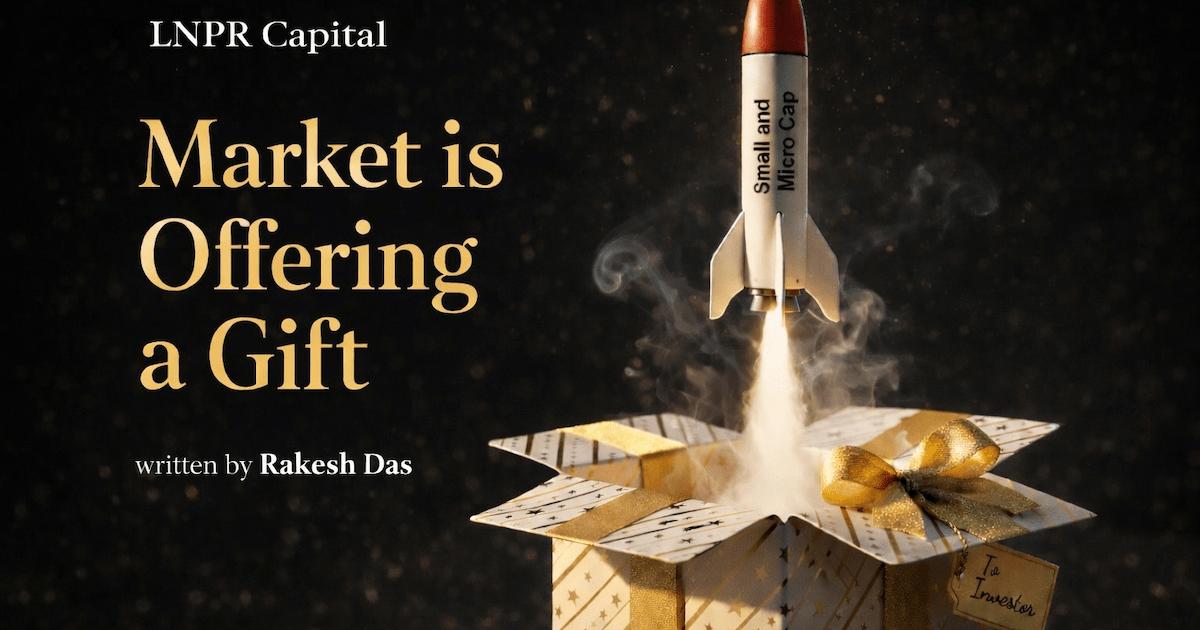
The market is offering you a gift. Most people will not take it because it does not feel like a gift right now — it feels like pain. That is precisely why it is a gift. The investors who will look back at this period five years from now with the most satisfaction are not going to be the ones who waited for certainty. They are going to be the ones who did the work, identified quality, and had the courage to act when everyone else was frozen.
At LNPR Capital, that is the work we do. And right now, it is some of the most exciting work there is.